
Client
Qualitative Methods Course
Project Type
UX Research
Project Year
2022
Role
UX Researcher
Exploring how everyday Instagram users save, organize, and revisit bookmarked content.
Instagram’s bookmarking feature allows users to collect and organize content they want to revisit later. Despite its popularity, the experience of navigating saved collections remains limited due to the absence of search and sorting mechanisms. This research project explores how daily Instagram users save, manage, and access bookmarked content and identifies opportunities to improve discoverability and organization.
Overview
With 72 percent of American adults using at least one social media platform, social media has become a critical space for communication, information sharing, and community engagement.
Instagram alone has over 1.4 billion global users. While the platform continuously evolves its content formats, the bookmarking feature introduced in 2016 remains an important mechanism for collecting and organizing content.
Saved posts are increasingly recognized as a meaningful engagement signal because they indicate a deeper level of user interest. However, accessing saved content can be difficult due to limited sorting and search functionality.
This project explores how Instagram users currently collect, organize, and revisit saved content and how those practices shape their information-seeking behaviors.

Research Framework
Perspective & Lens
This research draws on the Networked Knowledge Activities (NKA) Framework, which describes how people engage with knowledge in networked digital environments such as social media and online communities.
The framework identifies activities such as collecting, curating, and constructing information as key forms of knowledge management and creation.
Collecting and curating saved content on Instagram can therefore be understood as part of broader knowledge activities where users manage information for future use.
Previous research also identifies information seeking as one of the primary motivations behind social media usage, which guided the framing of this study.

Research
Applied Methods
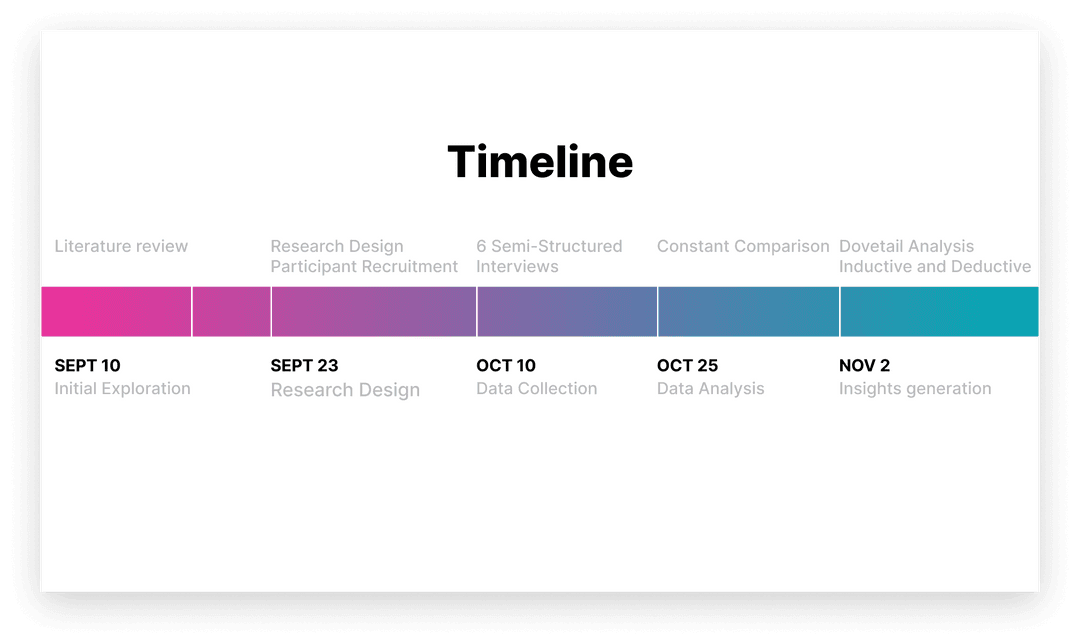
To recruit participants, I first posted a call for responses directly on Instagram asking followers about their bookmarking habits.
After receiving more than ten responses, I selected participants who frequently used the bookmarking feature and shared a pre-interview document outlining the topics we would discuss.
I conducted five semi-structured interviews lasting approximately 30–35 minutes each. This approach allowed participants to share detailed experiences while still maintaining a consistent structure across interviews.
Four interviews were conducted through Zoom while one interview was conducted in person.


Synthesis
Understanding the Data
Following the interviews, I conducted multiple rounds of qualitative coding to identify recurring patterns and behaviors.
Codes were iteratively compared and grouped into broader categories using an affinity clustering process.
This analysis resulted in six overarching themes that describe how users collect, organize, and revisit saved content.


Insights
Saved Content Patterns
Participants described saving content for multiple reasons including inspiration, tutorials, references, and ideas they wanted to revisit later.
Many users reported saving posts impulsively but rarely returning to them because locating older saved posts can be difficult.
Without search or filtering capabilities, users often rely on memory or manually browsing their collections to find previously saved posts.
This behavior highlights an opportunity to improve the discoverability and management of saved content within Instagram.
Reflection
Because this study is grounded in qualitative research, the findings should be interpreted as exploratory insights rather than universal conclusions.
To strengthen credibility, I triangulated findings using multiple data sources including interview transcripts, literature review insights, and reflexive analysis of my own assumptions.
The limited number of participants also introduces constraints regarding transferability, meaning the results may not represent all Instagram users.
Despite these limitations, the study highlights important usability challenges in navigating saved content and demonstrates the need for improved tools that support search, categorization, and retrieval of bookmarked posts.